Wednesday, July 18, 2012

The Tolerance Index: How Does the Denver Region Rank?


Image from Atlantic Cities and Martin Prosperity Institute

Richard Florida frequently cites "the three Ts" of economic development: technology, talent and tolerance as powerful factors driving a place's economic success.  In two recent posts on the Atlantic Cities web site, Denver is ranked 19th among large U.S.  metro areas and Boulder is ranked 9th among all U.S. metro areas on the Tolerance Index.   Components of the index include the percent of  residents who are foreign born, the concentration of gays and lesbians, and the level of segregation between  racial and ethnic groups.

Florida believes that the causal arrow runs from tolerance to economic success and not the other way around.   You can see on the map above that the Denver Region is a bastion of darker purple tolerance in a relatively sparse portion of the U.S.

Friday, July 13, 2012

Risks to Regional Green Energy Cluster

Long time readers of this blog know that I have been trumpeting the growth of and benefits from the green energy sector in Colorado.  A series of exogenous events are serving to undermine this cluster in the state and the U.S. 

In the wind energy vertical, the Federal renewable energy production tax credit (PTC) which provides an income tax credit of 2.2 cents per KW/hour of wind energy produced is set to expire on December 31, 2012 and appears to be another casualty of gridlock in Washington DC.   This has implications for employment in Colorado as companies like Vestas and their supply chain partners will basically stop making wind generation equipment in 2013, leading to large layoffs if this policy is not renewed.  It should be extended to provide a predictable environment for investment decisions, promote increases in renewable generation capacity, protect jobs and the environment, spur innovation and help U.S.-based facilities compete globally.

In the solar energy vertical, several high profile companies - including Loveland Colorado-based Abound Solar - have recently declared bankruptcy in the face of tough competition from Chinese manufacturers and headwinds from the weak economy.  Thus GE's recent announcement that
it will be suspending its plans to build the largest Solar factory in the U.S. for 18 months is particularly painful.

In the longer term, Colorado, the Front Range, and the Denver Region remain well positioned to benefit from an increase in demand for renewable energy but the short to medium terms seem to be filled with risks and disappointments.


Wednesday, July 4, 2012

More on the Patent Office

Graphic from U.S. Patent and Trademark Office Web Site
http://www.uspto.gov/

A few interesting tid bits on the Patent Office coming to the Denver region.

  • There is a pretty fierce debate on selecting a site for the office: Downtown Denver, Stapleton, Fitzsimons, the Tech Center, the Federal Center, or the former site of the University of Colorado Medical School off Colorado Boulevard.   This will be fascinating to see play out.

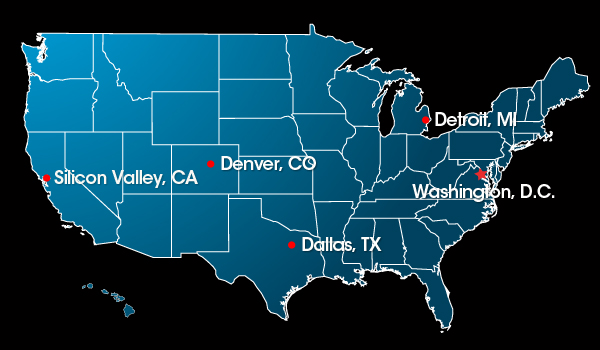
  • The Patent Office  Press Release announcing the selection of the three new satellite cities provides insight about the agency's internal perspective on the impact of these branch locations:
"The four offices will function as hubs of innovation and creativity, helping protect and foster American innovation in the global marketplace, helping businesses cut through red tape, and creating new economic opportunities in each of the local communities. Next week, Acting Secretary Blank and Under Secretary Kappos will travel to each of the newly selected cities to meet with local businesses, entrepreneurs and public officials to discuss the new office openings.
  • It is also interesting to see what the Patent Office had to say about their site selection criteria and methodology for choosing the three cities among hundreds of candidates in a supplemental document attached to the announcement press release.
"Selection of the four sites was based upon a comprehensive analysis of criteria including geographical diversity, regional economic impact, ability to recruit and retain employees, and the ability to engage the intellectual property community, among others...
The Dallas area provides the USPTO with a southern, central time zone hub from which to operate. The region is exceedingly rich in engineering talent, patent applicants, and patent grants. Dallas boasts an above average population of potential Veteran employees.

The Denver area provides the USPTO with a mountain time zone hub from which to operate. Empirical evidence demonstrates that Denver is a sought-after place to live and work with relatively low cost-of-living—a critical combination for the recruitment and retention of top talent. Further, the economic impact of a USPTO satellite office in the Denver region is projected to be disproportionate relative to most other cities. Denver also boasts an above average population of potential Veteran employees.

Silicon Valley provides the USPTO with a pacific time zone hub in the heart of California’s most vibrant innovation center. Silicon Valley, and the areas that surround it, contain many of the USPTO’s top filers as well as legions of start-up and small tech companies that depend on the USPTO. Further, Silicon Valley’s great quality of life and abundant population of engineering talent will provide fertile recruiting grounds for the Agency. The USPTO recognizes the challenges of retention in a hyper-competitive market, and will work to construct a concept of operations for the three offices that recognizes such challenges."

Sunday, July 1, 2012

Denver to Get Satellite U.S. Patent Office

The Denver Post and Denver Busimess Journal are reporting that the U.S. Patent Office will announce on Monday that the Denver Metro Area, Dallas-Fort Worth and San Jose will join Detroit as one of four cities where the U.S. Patent Office will open a satellite branch. This is another big win for economic development in the Denver Region as the presence of this office will accomplish several major objectives: help strengthen the Metro Denver region's competitive site selection position in drawing innovative high techology companies and researchers who generate patents by making it logistically easier for these entities to apply for and recieve patents when located in Colorado; increase Denver's attractiveness to professional, legal and financial services comapnies who support technology companies; provide hundreds stable of well paying regional jobs; and send a signal to investors, entrapranuers and knowledge workers that Denver is a great place invest, work and live.

Many political, business and civic leaders did a great job of selling the state and region.  See The Case for a Satellite Patent Office in Colorado as a very well constructed piece of marketing collateral for the Denver Region.

Colorado Senator, Micahel Bennet, who was a key advocate for Colorado and sponsored the legislation which authorized creating Patent satellite officers issued a press release praising the decision:

"This is a well-deserved victory for the state of Colorado,” said Bennet. “This tremendous news affirms what we already know about our state – that we are leaders in innovation, technological development, and economic growth. The new office will provide a boost to the growing high-tech industries in Colorado, such as the bioscience, clean energy, and aerospace fields.

“The work to bring the patent office to Denver was a truly collaborative effort that included bipartisan support in government, the business community, academia and from local leaders across the state. In particular, patent attorney John Posthumus has worked tirelessly for years as one of the leaders to make this a reality. The patent office will anchor Colorado’s reputation as a leader in innovation and the 21st century economy and will benefit the state for many years to come."

Sunday, June 10, 2012

Northwest Rail Line Delay Upsetting and Disappointing

For those people living in or commuting to Boulder County, Broomfield and Westminster, the "perfect storm" of sales tax revenue shortfalls (due to the Great Recession) and higher than budgeted for costs ($1.7B versus original $461M estimate), which have contributed to a potential multi-decade delay on the construction of the Northwest Corridor Rail Line (to 2042 from 2016), there is legitimate anger, disappointment and cynicism. 
Image from RTD

Taxpayers in the Northwest Corridor (Longmont, Boulder, Louisville, Superior, Broomfield and other places) have been paying an extra .4% of sales tax into the FasTracks revenue pot since 2005 helping to jump start planning and construction for other rail lines while the possibility of their rail line has receded into a murky, uncertain and distant future.  Boulder County voters want to stick to the commuter rail plan and are pushing RTD for guarantees about delivery and timing.  Commuters along US 36 have been underwhelmed by the prospects for Bus Rapid Transit Improvements along the US 36 Corridor from Boulder to Denver.  Voters, commuters, and taxpayers are cranky and there is a general sense of discontent, discouragement and distaste about the process and the outcome.

While these are all valid responses to the situation, its important to not lose sight of the concrete benefits that have come and are coming to commuters on the US 36 Corridor from the development of the Bus Rapid Transit (BRT) system.  These real, tangible, cumulative,ongoing benefits will promote mobility, regional economic vitality and can demonstrate the importance of transit infrastructure investments and ultimately help make the case for the importance of building the complementary Northwest Rail Line.

Over the next several months I will be writing a series of blog posts talking about BRT on the US 36 Corridor to explain what has happened, is happening and what the outcomes are and why this is important to the region.

Sunday, June 3, 2012

Denver Region on the Right Side of College Educated Work Force Divide

According to Brookings Data published in the New York Times, the Denver Region has the ninth highest percent of college graduates (the region would rank higher but Boulder is not included).  This is a self reinforcing phenomina which over the long term will play a key role in the economic vitality of the region.

Sunday, May 27, 2012

Denver To Tokyo Finally A Reality

The recently announced United Airelines Flight from Denver to Tokyo is a big boost to Denver's Status as global business and tourist destination.  This has been a long time coming and big congradulations are due to all the parties who worked to make this happen.  Certainly the launch of the Boeing 787 made this flight economically  feasible.  It will be fascinating to see if any other long haul international flights get added to DIA.


Poster image from www.rockymountainnews.com, photo by City of Denver; Business Groups.

Sunday, January 1, 2012

Personal Thoughts: A Return to Colorado, the Importance of Transit Investment

I began this blog more than four years ago in 2007 as a way to stay connected with economic development issues in my hometown region of the Denver Metro Area.   About six months ago I moved back to the Front Range.  Now after 25 years I am a resident again in my hometown of Boulder Colorado.   I am very thankful to be able to help out and keep an eye on an aging parent who only lives a mile away from me.

Since I left Colorado I have been fortunate to  have lived in regions with strong public transportation systems: Boston, London, New York, San Francisco, Washington DC.   Despite many many return visits to Colorado and the careful watch I have kept over the FasTracks developments, I was really not sure what the day to day experience would be in using Mass Transit in the Boulder/Denver Area.

My first thought is I have been pleasantly surprised.   I am very appreciative of how well connected Boulder is to Denver via the BF/BX/BV routes and how well served Denver itself is by local bus routes.   Both my wife and I are frequent users of these routes for commuting and personal trips.   However, as good as this system is, there are big gaps that need to be filled.

As the national economy struggles, concerns about environmental sustainability continue and the likelihood of energy price increases remain, my thoughts keep returning to the great wisdom of the Denver Metro Area's plan to build FasTracks.  

The timing of this investment could not be more critical: it is creating job in a weak economy, providing more sustainable transit alternatives to a congested region, promoting economic vitality and regional competitiveness along the Front Range, and helping facilitate an increase in population while protecting the quality of life. 

Over the next few years the Denver region will come to another transit cross roads.   We will have to decide if we are willing to pay higher taxes to fund transit infrastructure investments to complete the FasTracks build out and take our transportation investments to the next level of vision---or retrench while the historic opportunity to make the Denver region a world class metropolitan area recedes backwards.   In my mind this is one of the two or three most important regional economic development questions the Denver Region will face and we will have to live with the consequences of our choice for decades to come.

Sunday, December 18, 2011

Space Industry Moves Forward in Colorado

I was talking to friends last week about an investment property they are buying in Loveland.  They mentioned they were excited about the prospects for the thousands of potential new jobs which could be created in Loveland by the ACE industrial park joint venture between NASA, the Colorado Association for Manufacturing and Technology and a private real estate developer.   My first reaction was that the park's future was uncertain because the original developer, United Properties, stopped its negotiations with the City of Loveland to buy the Agilent Technologies Inc property.  However, I was excited to learn that a new developer, Cumberland & Western Resources LLC is close to buying the property and moving the project forward.


The Space economy is very important to the Front Range and has prospects for future growth even beyond the ACE park.  According to the Colorado Space Coalition the aerospace industry in Colorado employees 163,000 people and the state has the 3rd largest space economy in the U.S.

Recently Governor Hickenlooper announced that the State of Colorado is applying for a spaceport designation from the Federal Aviation Administration.   "Spaceport Colorado" is tentatively slated to be located at Front Range Airport near Watkins and east of Denver in Adams County.  The creation of a spaceport in Metro Denver would likely promote economic and real estate development in the vicinity of the facility.

Both the ACE park and Spaceport Colorado will be very interesting to watch develop over the next few years.

Saturday, November 26, 2011

Uncertainty Surrounding Former StorageTech Site Illustrates the Drawbacks of Relying on Out of Region Firms for Economic Development

The redevelopment of the former Storage Technology Site in Louisville into a training and R&D facility for ConocoPhillips was going to provide an economic boost to the "Renewable Range" cluster of green energy firms in the Denver region and to the broader economy.  

However, recent uncertainty over the future of the site illustrates the drawbacks of not having homegrown, in-region headquartered firms driving economic development decisions.  When Houston-based ConocoPhillips announced a split into two separate publicly traded companies, ConocoPhillips, an upstream exploration and production energy company and Phillips 66 a downstream consumer-facing refining, marketing and midstream business, the plans for the Louisville campus came into question.  Future decisions will be made by the leadership of Phillips 66 and may or may not reflect the previous vision espoused by the legacy ConocoPhillips leadership.   When land use decisions are made by companies with distant, out of state headquarters, there is an exposure to changes in strategic and leadership direction which can imp3de local progress.

Here is to hoping this site still gets redeveloped by Phillips 66 in a way  that enhances the regional green energy cluster and boosts the overall economy in the Metro Denver area.

Sunday, November 20, 2011

Denver "Cool City" for Young Adults During Recession....But Can The Area Retain This Talent?

William Frey from the Brookings Metropolitan Policy Program recently released demographic data showing that the Denver Metro Area had a net gain of more than ten thousand young adults (aged 25 to 34) from 2008 to 2010 making it the number one gaining Metro Area in the U.S. during the Great Recession.   It jumped from a ranking of twelfth in 2005 to 2007 (see chart to left from Brookings).

Frey describes the strong net inflow performance of cities like Denver in the following way:


"To the extent they are moving at all, young adults are headed to metro areas which are known to have a certain vibe—college towns, high-tech centers, and so-called 'cool cities.'...The top three areas [Denver was number 1] and our nation’s capital, arguably, fared relatively well economically during the recession. But all seven are places where young people can feel connected and have attachments to colleges or universities among highly educated residents."


Which brings me to a fascinating conversation I had the other night at dinner with an old friend I used to work with in New York.  My friend, who has lived in the Denver Metro Area for more than 10 years, has top notch professional and academic credentials with many interesting and impressive career experiences.   One thing he told me was that, in his experience, the relatively small size of the Metro Denver employment market leads many talented people to ultimately move on to larger business centers to further their careers.  

Clearly the Denver region is attracting energetic young people who are critical for keeping the area economically vital, creatively vibrant and providing a strong labor talent pool.  However, the big question this raises in my mind is "Can the region attract and/or organically grow enough top tier job opportunities to retain this population as it ages and grows into senior management roles?"

This is a big and critical challenge for the Denver region.

Thursday, October 13, 2011

Two for Two, Colorado Over New York: GE Selects Aurora Site for PrimeStar Thin Film Solar Plant

The Centennial State is on a two-day site selection roll over the Empire State as Colorado won out over New York State for the location of a thin film solar factory for newly acquired General Electric subsidiary PrimeStar. Given the Arrow Electric news from yesterday it has been a good economic development week for the Denver Region.

It is particularly notable that PrimeStar was a Colorado company which developed the underlying technology with the National Renewal Energy Laboratory in Golden. So the full product life cycle from basic R & D to product development to commercial production will all be vertically integrated within the state of Colorado.

The hundreds of manufacturing jobs offered by this plant will boost local labor and real estate markets and reinforce the renewable energy cluster in the Front Range. I don't know if GE will be exporting any of these panels outside this U.S. but this also has the potential to boost Colorado's weak export numbers.


Wednesday, October 12, 2011

Right on Target: Arrow Electronics Moves Global HQ to Colorado

In a time of high economic anxiety, the announcement that Fortune 200 company Arrow Electronics is moving its global headquarters to Arapahoe County, Colorado from Long Island in New York is great news for Metro Denver from an economic development perspective.

See an excellent series of article from the Denver Post: Hickenlooper's role, article with analysis and graphics, the role of tax credit incentives, and breaking news article by Post writers Svaldi and Griffin.


Arrow Electronics Press Release.


Earlier blogs about the dearth of Fortune 500 Headquarters in Colorado here and here.

Monday, June 27, 2011

Difficult Questions Surround the Stock Show Relocation Plan

The emerging donnybrook between the cites of Denver and Aurora over Gaylord Entertainment's proposed hotel and theme park complex at the High Point Development near DIA raises some of the most vexing economic development questions to hit the Metro Denver region in several years.


  • Will the proposed development, near DIA and along the planned airport train route, promote regional economic well being or drain energy and convention business from the Metro Area's urban core in downtown Denver which has been so painstakingly built up over the past few decades?


  • Should the State of Colorado award a multi-hundred million dollar tax increment financing subsidy, perhaps the largest ever in Colorado, to help build 1,500 hotel rooms and 500,00 of convention space in Aurora?


  • Is this plan the only way to ensure the cherished National Western Stock Show is revitalized and modernized and stays in Colorado for the foreseeable future?
    Can Denver and Aurora find a formula for approving the Gaylord project, keeping the Stock Show in Denver and making sure their is an equitable distribution of economic benefits and costs flowing from any potential related new developments?


  • Will Governor Hickenlooper play a role in this deal?

The Denver Post has an excellent primer exploring these issues.


A View of the Rockies will be closely studying this situation in the coming weeks and months. So far we don't know enough to have an informed opinion.

Saturday, June 11, 2011

The Denver Way

Growing up in Colorado and living as an adult in Boston, New York, San Francisco and now New Jersey, I have always admired the State of Colorado and its cities like Denver for having decent, effective, well-run governments that are able to make decisions and execute projects to promote civic improvement. As a young, western city without the types of entrenched establishment interests and ethnic tribalism that exist in some older locales, Denver seems to exhibit an openness to newcomers and new ideas.


Economic development gurus like Richard Florida argue that a key to attracting the creative, information savvy workforce needed to power the economies of today and tomorrow is openness to ideas, lifestyles, cultural variety, ethnic and racial diversity and other differences among people.

The election of Michael Hancock as Denver's 44th Mayor is instructive. The city's last four elected Mayors come from diverse backgrounds: African American, Caucasian, and Hispanic. The fact that two of the last three people elected mayor of Denver have been African American, in a city in which only 11% of the population is black, is particularly striking and strong evidence that Denver is a relatively open and tolerant city.

It seems to me that a repeated willingness of a citizenry to elect leaders from different racial and cultural backgrounds to top level positions, is a compelling example of openness and tolerance and will go a long way toward promoting the "Denver brand" to the creative class.